


Fatigue and drowsiness
108 adults over 65. 250 mg NMN daily for 12 weeks, randomised and placebo-controlled. Participants taking NMN in the afternoon showed significantly lower drowsiness and lower total fatigue scores than placebo. ³

Your energy didn’t just disappear with age and after illness. Your cells may be producing less of it.
Pacing yourself means treating your energy like a phone battery. You use it carefully. You switch to low power mode before you hit empty, and you save some for what matters most.
It helps. But it only manages the energy you already have. If you start every day with a low battery, pacing yourself doesn’t help you recharge.


Every cell in your body uses NAD⁺ to turn food into usable energy. Low NAD⁺ means less energy, no matter how well you eat, sleep or pace yourself.
As you get older, two things happen at once. Your body starts burning through NAD⁺ faster, using it to repair everyday cell damage. At the same time, it gets worse at recycling NAD⁺ back into a usable form. So you're losing it faster and replacing it slower.
Result: By 40, roughly half your NAD⁺ is gone. Less fuel, less energy — and it happens whether you eat well, sleep well, or not.
Studies shown that conditions like Long COVID can drain your NAD+ levels even further.

More NMN in, more NAD⁺ made, more energy delivered.

PureLane Labs

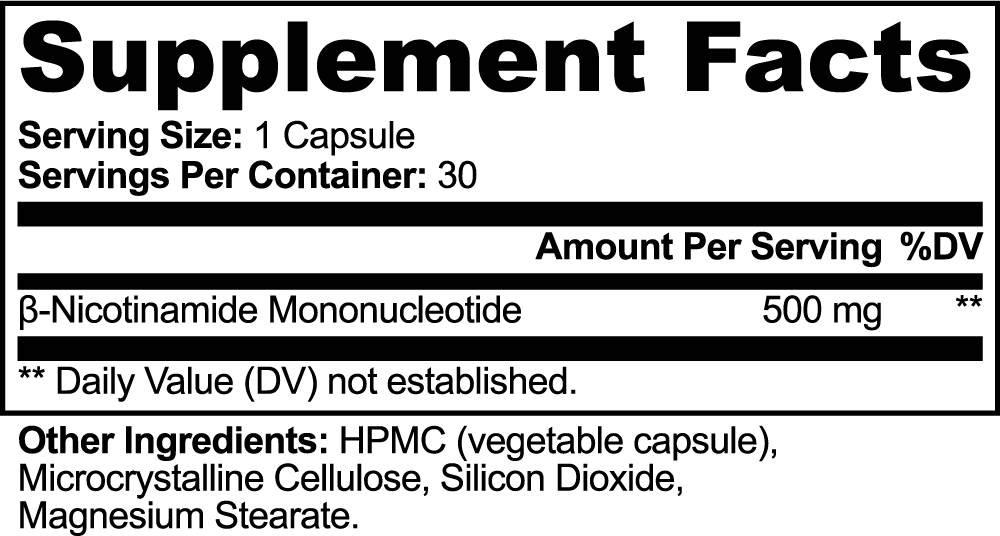
PureLane NMN provides 500 mg of β-nicotinamide mononucleotide per capsule, at 99.9% purity. Each bottle contains 30 capsules — a one-month supply at one capsule daily.
NMN is a naturally occurring compound that acts as a direct precursor to NAD⁺ (nicotinamide adenine dinucleotide), a coenzyme found in every cell and central to how cells produce energy from food. NAD⁺ levels decline with age.
The formula contains NMN and a vegetable capsule shell — no fillers, binders or additional active ingredients.
One capsule in the morning, with or without food.
Morning is recommended because NAD⁺ follows a daily rhythm and is naturally highest early in the day. Taking it later isn't a problem — it's simply further from that rhythm.
Consistency matters more than exact timing. Take it daily without breaks.
It can be taken alongside coffee. NMN is not a stimulant and doesn't act on adenosine, the pathway caffeine works on.
Every batch is tested by an independent laboratory before it ships — for NMN content, heavy metals and microbial contamination. All results must meet specification before a batch is released.
PureLane is manufactured in a cGMP-certified facility in the United States.
Orders are dispatched from the United States within 1–2 business days. You'll get tracking by email as soon as your parcel leaves the facility.
Take it for 60 days. If your energy has't changed, send us the empty bottles & we'll refund all of them.
Full details: Shipping Policy · Refund & Returns Policy


 PureLane NMN
|
 Caffeine
|
 Vitamin B
|
 Magnesium
|
 Creatine
| |
|---|---|---|---|---|---|
| Restores the fuel your cells run on (NAD⁺) | Yes | No | Depends on form or dose | No | No |
| No crash or dip afterward | Yes | No | Yes | Yes | Yes |
| No dependency or tolerance buildup | Yes | No | Yes | Yes | Yes |
| Won't interfere with sleep | Yes | No | Depends on form or dose | Yes | Yes |
| Works even if you're not deficient | Yes | Yes | No | No | Yes |
| No water retention or weight gain | Yes | Yes | Yes | Yes | No |
108 adults over 65. 250 mg NMN daily for 12 weeks, randomised and placebo-controlled. Participants taking NMN in the afternoon showed significantly lower drowsiness and lower total fatigue scores than placebo. ³
80 healthy adults aged 40–65. Placebo, 300 mg, 600 mg, or 900 mg daily for 60 days. Blood NAD⁺ rose significantly at every dose versus placebo and baseline. Six-minute walking distance improved across all NMN groups. ⁵
48 recreational runners aged 27–50, six weeks, randomised and double-blind. Oxygen uptake and ventilatory threshold improved more in the 600 mg and 1,200 mg groups than placebo. ⁴
Liao et al., J Int Soc Sports Nutr, 2021 (opens in a new window)
36 healthy middle-aged adults, 250 mg daily for 12 weeks. NMN was well tolerated with no adverse events reported, and elevated NAD⁺ metabolism. ⁶
Take it for 60 days. If your energy has't changed, send us the empty bottles & we'll refund all of them.
9 out of 10 people report the same experience. They take one NMN (500mg) capsule each morning, with or without food — consistency matters more than timing.
No jolt, no crash — that's the proof this is NOT a stimulant. NMN restores NAD⁺ in the background, so the energy is real, not borrowed.
Right on schedule — this is when energy starts to shift for most people.
Steady energy through the afternoon, no slump, a clearer head, and plenty left in the tank for the evening.*
Both are precursors to NAD⁺, the coenzyme your cells use to turn food into usable energy. The difference is how many steps it takes to get there: NR (nicotinamide riboside) converts to NMN first and then to NAD⁺, while NMN converts in a single step.
One capsule in the morning, with or without food.
Morning is recommended because NAD⁺ follows a daily rhythm and is naturally highest early in the day. Taking it later isn't a problem — it's simply further from that rhythm.
Consistency matters more than exact timing. Take it daily without breaks.
Weeks, not days. Most people start noticing a difference somewhere between weeks two and four — some sooner, some later.
NMN isn't a stimulant, so there's nothing to feel on day one. It works by building NAD⁺ back up gradually, which is why we suggest giving it at least two months.
NMN is not a stimulant. It does not act on adenosine, the pathway caffeine works on, so there is no mechanism by which it would keep you up the way a coffee at 6pm does.
Mornings work best because NAD⁺ follows a daily rhythm and is naturally highest early in the day. Taking it later isn't a problem — it's just further from that rhythm.
Yes. They are not doing the same job.
Caffeine blocks the signal that tells your brain you are tired — useful, fast, and temporary. NMN supplies a precursor your cells convert to NAD⁺, which is part of how they produce energy in the first place. One does not replace the other, and taking them together is fine.*
It sits in the middle of the range used in human research, which runs from 250 mg to 1,200 mg a day.
We chose 500 mg because it delivers a meaningful dose in a single capsule — nothing to split, nothing to remember twice a day.
Generally yes — NMN is a single compound with no known interactions with common vitamins or minerals.
If you are taking prescription medication, are pregnant or nursing, or are managing a health condition, talk to your doctor before starting this or any supplement.
NMN is generally well tolerated. Most people take it daily without any issues, and it isn't a stimulant, so it doesn't cause jitters or affect sleep.
Everyone is different, though. If anything feels off, stop taking it and speak to your doctor. The same goes if you're pregnant, breastfeeding, or taking prescription medication — check with them first.
NMN is sold widely in the United States.
Yes. Every batch is tested by an independent laboratory before it ships — for NMN content, for heavy metals and for microbial contamination.
Email us and we will send you the full certificate of analysis for the lot in your bottle.
30 days, no conditions. If you do not feel a difference, or you simply change your mind, email us and we will refund you in full.
Not currently. We ship within the United States only.